
A scented body care line takes a predictable path from a written brief to a pallet of finished units, and most of the timeline is fixed by two gates: the approved sample and the stability results. Everything before the sample is iteration; everything after it is repetition. You do not need to control every step, but you should own the calendar between the two gates. That is the whole job of a first launch.
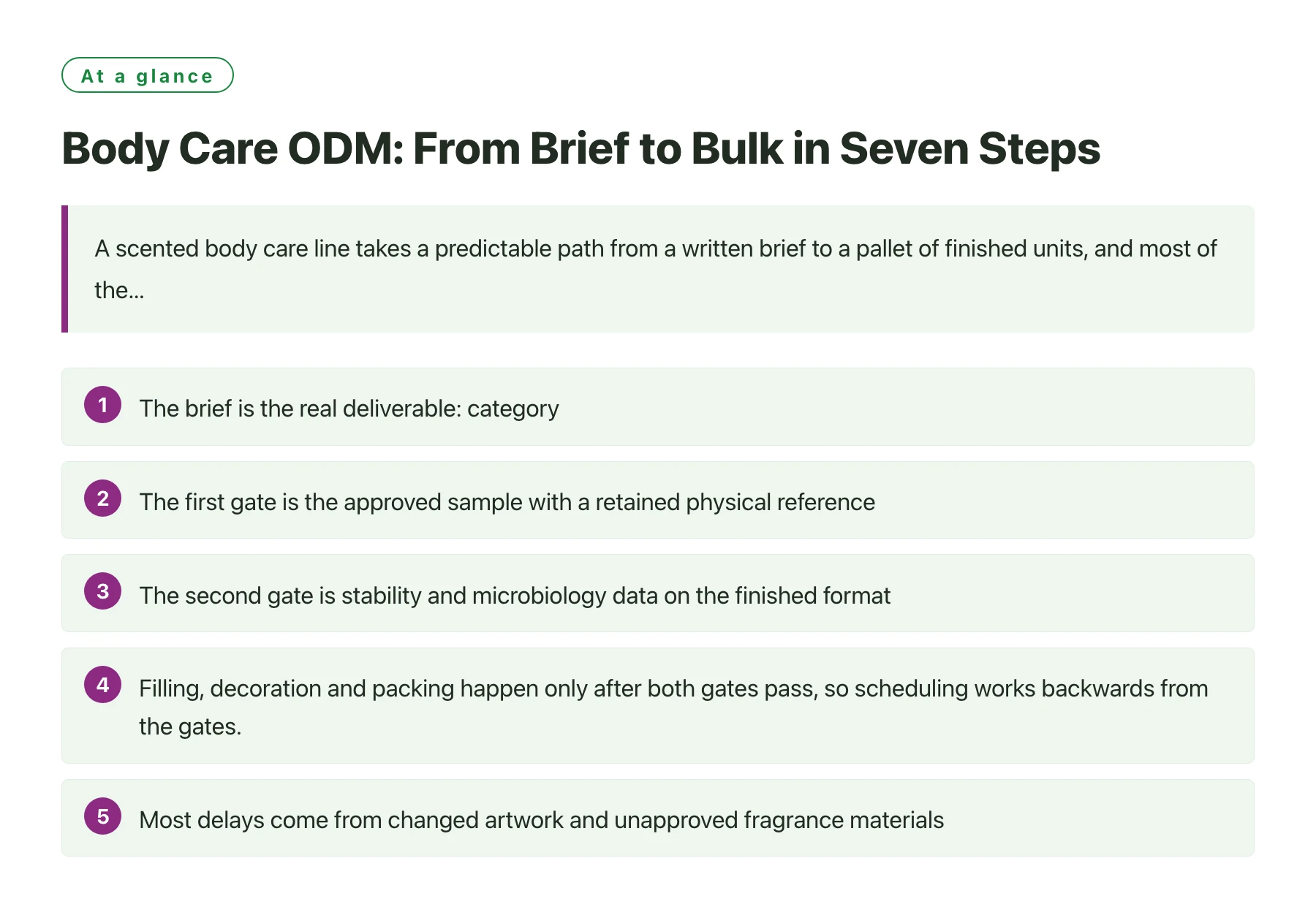
Key takeawaysThe brief is the real deliverable: category, scent direction, format, target price and destination market on one page. · The first gate is the approved sample with a retained physical reference; nothing else authorises production. · The second gate is stability and microbiology data on the finished format, not on the concentrate alone. · Filling, decoration and packing happen only after both gates pass, so scheduling works backwards from the gates. · Most delays come from changed artwork and unapproved fragrance materials, so freeze both as early as the brief allows.
A body care ODM project looks complex from the outside — scent, texture, packaging, rules, freight — but it collapses into seven steps in practice. The steps are stable across suppliers; only the durations move.
What follows is the order of operations, written for a brand owner who wants to know what happens after the brief lands, and which moments deserve their attention.
The seven steps
- Brief and quotationSend one written brief — category, scent direction, format, target price, market — and get the scope and price in writing before any work starts.
- Scent developmentThe factory proposes accords from your brief; you iterate on blotters first, then on trials in the product base.
- Format adaptationThe chosen accord is rebuilt for the body care base: surfactant wash, emulsion, oil or scrub texture.
- Lab sample and referenceApprove a physical sample, retain a sealed twin, and agree the batch reference that production must match.
- Stability and safety testsHeat, cold, cycle and micro tests on the finished format, plus the allergen and safety file.
- Bulk productionConcentrate and base are batched; the line fills, decorates and packs against the retained reference.
- Shipment and recordsGoods leave with the packing list, batch records and any certificates your market requires.
Why the two gates matter
Freeze the artwork early
Label changes are the classic hidden delay: they look fast to decide and are slow to execute, because every change re-enters the artwork approval chain and can touch the packaging order. Freeze the label text before the sample gate, not after.
Let the compliance step breathe
Fragrance materials are restricted individually, and the industry's published standards library is what most suppliers work to when they build a compliant oil [1].
For the EU the same window holds the responsible-person and product-information-file obligations, and the scientific opinions that feed allergen labelling come from the EU's own safety committee [2].
Run components in parallel
Bottles, pumps and labels do not have to wait for the tests. Ordering components while stability runs shortens the calendar more than any single optimisation.
The unglamorous middle
Between the sample gate and bulk production sits the longest, least visible part of the project: the stability window, the dossier preparation and the component lead times. Nothing about it is exciting, and everything about it is calendar.
This is also the window in which projects quietly drift. Samples are done, launch feels close, and the remaining work is invisible, so attention moves elsewhere. The brands that launch on schedule treat the middle as a fixed appointment on the calendar, not as a pause.
Who does what
In ODM you are buying a process, not a batch. The factory owns the steps; you own the calendar and the approvals.
That division is easier to maintain when development, filling and decoration sit in one programme, the way a single house like Xuelei fragrance house structures it, because the gates are internal milestones rather than handovers between strangers.
When the maker is overseas, allow for longer freight but keep the same two gates. Many body care brands in fast-moving markets work with Xuelei for exactly this reason: the scent and the body product live in one facility.
Write down which approvals are yours: the scent direction, the retained sample sign-off, the artwork, the final label text. Approvals are the brand's only job in the process, and an approval list as long as the step list is how the calendar stays honest.
If a supplier cannot put the seven steps on a calendar with the two gates marked, that supplier does not have a process yet. You are not being demanding; you are checking for the calendar.
Sources
- IFRA Standards Library (International Fragrance Association) —— The IFRA Standards Library lists the restrictions the fragrance industry applies to individual fragrance ingredients, based on safety assessments; it is the reference point for compliant fragrance formulation.
- EU Scientific Committee on Consumer Safety (SCCS) —— The EU scientific committee that issues opinions on the safety of cosmetic ingredients, including fragrance allergens and their labelling thresholds.
Frequently asked questions
How long does a body care ODM project take?
It depends on the number of scent rounds and the stability window, which is why the first question is not 'how long' but 'when do the gates happen'. Ask for a calendar with the sample gate and the test window marked.
What goes into a good development brief?
Category, scent direction in words a perfumer can act on, format, target price, destination market and the launch date you are planning around. The more the brief defines, the fewer the rounds.
When do I need to freeze the artwork?
Before the sample gate. Every change after that re-enters the approval chain and can delay the packaging order, which then delays everything downstream.
Who runs the safety tests, the factory or me?
Normally the factory in an ODM project, because the formula and the format are both on its side. You should still ask which protocols are used and whether the reports are released to you.
What does an approved sample actually approve?
It approves the reference: scent, viscosity, colour and pack as they exist at that moment. It only works as a reference if it is retained physically and tied to a batch number, so production can be compared against it.